From 2026, the CBAM regulation has entered into full application
EU Climate Policy: From the EU ETS to CBAM
The European Union Emissions Trading System (EU ETS) has been one of the EU's key climate policy instruments since 2005, designed to reduce greenhouse gas (GHG) emissions.
The system is based on the cap-and-trade principle. This means that a maximum limit (or cap) is set on the total amount of GHG emissions that installations covered by the system may emit. The cap is gradually reduced over time, ensuring that overall emissions across the EU continue to decline and climate objectives are achieved.
To protect EU industry from the risk of carbon leakage, companies receive a certain number of free emission allowances. One allowance gives the holder the right to emit one tonne of CO₂ equivalent. Companies that emit less than their allocated amount may sell their surplus allowances on the market or save them for future use. Companies that exceed their allocation must purchase additional allowances from other market participants.
Because the total number of allowances is limited, they have a market value. Their price fluctuates according to supply and demand, creating a strong economic incentive for businesses to invest in cleaner technologies rather than purchase additional allowances.
At the end of each year, industrial installations covered by the EU ETS must surrender enough allowances to cover all of their verified GHG emissions. If a company reduces its emissions, it may retain unused allowances for future compliance or sell them to another company that requires additional allowances.
Over the past two decades, the EU ETS has continuously evolved. Today, it covers not only industry and power generation, but also the maritime transport and aviation sectors.
A closer look at the changes from 2026
To further reduce the risk of carbon leakage and create a level playing field for European industry, the European Union has implemented the Carbon Border Adjustment Mechanism (CBAM). CBAM is an important component of the EU's climate policy.
Its objective is to ensure that products imported into the EU are subject to carbon costs equivalent to those faced by goods manufactured within the EU under the EU ETS.
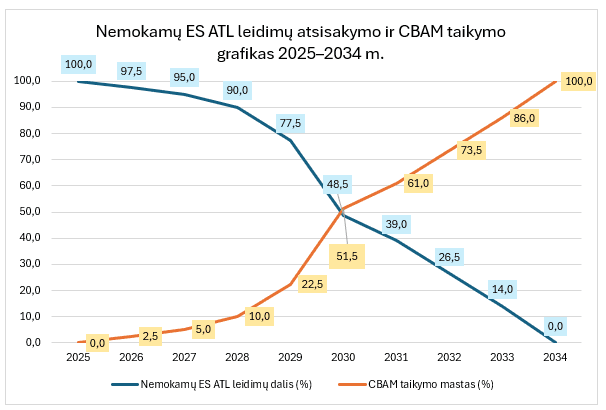
In addition to placing a carbon price on carbon-intensive imports from third countries, CBAM gradually phases out the free emission allowances previously granted to EU industrial sectors. In 2026, EU industry will continue to receive 97.5% of its free emission allowances, while by 2033 this share will be reduced to 14%.
From 2026, Importers Must Purchase CBAM Certificates
From 1 January 2026, importers will be required to purchase Carbon Border Adjustment Mechanism (CBAM) certificates corresponding to the greenhouse gas (GHG) emissions generated during the production of imported goods. At present, this requirement applies to six carbon-intensive sectors: cement, hydrogen, aluminium, iron and steel, electricity, and fertilisers.
Preparing for CBAM compliance
Companies importing 50 tonnes or more per year of goods listed in Annex I of Regulation (EU) 2023/956 from third countries into the EU customs territory must apply for Authorised CBAM Declarant status (more information). Instructions on how to submit an application are available here.
From 1 January 2026, only companies that have either been granted Authorised CBAM Declarant status or have submitted an application for that status may import CBAM goods into the European Union.
How does CBAM work?
CBAM is implemented through the purchase and surrender of CBAM certificates. Importers must acquire certificates corresponding to the greenhouse gas emissions embedded in the production of imported goods.
One CBAM certificate represents one tonne of CO₂ emissions associated with the manufacture of imported products.
The purchase of CBAM certificates will begin on 1 February 2027, covering imports made during 2026 and the first quarter of 2027.
EU Member States will sell certificates through a central platform operated by the European Commission. The price of CBAM certificates will be linked to the auction price of allowances under the EU Emissions Trading System (EU ETS).
For 2026, the CBAM certificate price will be calculated as the average quarterly EU ETS auction price. From 2027 onwards, the European Commission will publish the certificate price on a weekly basis.
Emissions must be verified by an accredited verifier
From 2026, greenhouse gas emissions generated during the production of imported goods must be verified by an independent accredited verifier.
Where actual embedded emissions cannot be verified by an accredited verifier - and unless the European Commission provides otherwise -importers holding Authorised CBAM Declarant status may use the default emission values established by the European Commission, increased by a 1% adjustment factor, when preparing their annual CBAM declaration.
The CBAM declaration for 2026 must be submitted by 30 September 2027.
Importers of fertilisers should note that they must declare not only direct production emissions, but also indirect emissions resulting from the electricity consumed during the manufacturing process.
Note: Where actual emissions cannot be verified by an accredited verifier, the European Commission's default emission values may be used, increased by a 1% correction factor.
Relevant implementing regulations
- Commission Implementing Regulation (EU) 2025/2620 of 16 December 2025, laying down rules for the application of Regulation (EU) 2023/956 regarding the calculation of adjustments to the number of CBAM certificates to be surrendered, taking into account the allocation of free EU ETS allowances.
- Commission Implementing Regulation (EU) 2025/2621 of 16 December 2025, laying down rules for determining default emission values under Regulation (EU) 2023/956.
Carbon pricing already paid in the country of origin
Under Regulation (EU) 2023/956, importers may reduce the number of CBAM certificates they are required to surrender by the amount of emissions for which a carbon price has already been effectively paid in the country of origin, provided the applicable conditions are met.
For more information, please visit the Environmental Protection Agency (Lithuania) website.